RTX 5090: three candidate families, useful tuning, no promotion
Date: 2026-11-03. Scope: one RTX 5090, Windows/Docker Linux VM, direct online endpoints; bounded coding and synthetic capability tests. Decision: challenger evidence, no-promotion.
Result card
Three candidate families each produced a configuration that passed the local coding fixture. The campaign did not qualify an equivalent replacement for the reference service.
| Setup | Recorded value |
|---|---|
| Models | Private candidate on Ignis; QAT candidate; coding-focused candidate; private reference. Exact variants and asset fingerprints withheld. |
| Hardware | One RTX 5090, 32 GB class; no other GPU measured |
| Runtime and recipe | Ignis 0.8.0 and separate NInfer configurations; sanitized controls |
| Measurement path | Direct online requests; repeated prompts with observed prefix reuse, not cold-only |
| Coding contract | Seven Python task types × three repetitions; 21 solutions and 123 behavioral checks per profile; temperature 0, total completion cap 12,288 |
| Context/modality | Configurations differ: 128K text, 160K text or image, and 256K image; primary requests sequential C1 |
| Evidence | Bounded quality, functional and capacity diagnostics; full serving comparison incomplete |
| Decision | No promotion; declared reference policy restored at campaign close |
| Headline measurement | Local result | Conditions |
|---|---|---|
| Fresh coding candidate | 123/123 checks; 21/21 solutions | 128K configured, text-only, fresh process; median task latency 0.886 s |
| Restored reference | 114/123 checks; 15/21 solutions | 160K configured, vision enabled; median task latency 1.399 s |
| Ignis budget follow-up | 111/123 → 123/123 | Matched 32K controls except thinking budget 1,024 → 4,096; summed task latency 99.145 → 305.500 s |
| Ignis larger-profile retrieval | 45/45 | Sequential synthetic cases through 245,646 actual input tokens, configured 262,144; reasoning disabled |
| Ignis image assertions | 18/18 | Seven synthetic images, six types × three repeats; incidental unsupported claims remain |
| Negative result | QAT vision startup failed | Text-only sibling passed; no vision qualification transfers |
Values derive from the summary and all coding cohorts with native links.
Why it matters: the coding candidate deserves a held-out coding follow-up; Ignis offers useful bounded context/image behavior, with a material reasoning budget tradeoff. Faster settings sometimes broke correctness.
Important caveat: checkpoint, runtime, reasoning, context and modality differ. This is not a general model or engine ranking, a complete serving comparison, or an equivalent-main replacement result. Public identity/text redactions also prevent independent exact replay.
Artifact manifest · Evidence index · Publication summary · Ignis use and improvement note
Outcome and decision
The fresh 128K coding candidate passed every fixture check with lower observed task latency than the restored 160K image-capable reference. That comparison does not establish vision parity, a matching context envelope, repository repair, or superior performance on other workloads. It supports a focused next trial.
The compact Ignis profile and QAT no-speculation profile also passed all coding checks, with higher task latency. QAT speculative settings scored 120/123 and 117/123; returning to no speculation recovered 123/123 and identical visible sources to its original control. Speculation and proposal-head/load-path changes are coupled, so this is not a general numerical-mechanism claim.
All campaign test containers were unloaded and the declared reference policy was restored. Exact pre-campaign immutable capture was incomplete: restoration proves declared policy and a fresh observed process, not equality to an uncaptured original container. This publication makes no live deployment claim.
Configuration and method
The configuration description separates profiles and request-level reasoning modes. The run map is retrospective, not a fabricated pre-request plan.
The seven-task list is in the workload manifest. Generated Python was reviewed before execution with an AST allowlist, an independent deterministic behavioral oracle, isolated child process, two-second deadline and 256 MiB OS limit. Those controls are not a security sandbox. Model self-assessment was not the acceptance gate.
Seven repeated task types are not 21 independent tasks. Temperature zero and prefix reuse produced repeated identical answers. The 4,096 visible plus 8,192 reasoning headroom fields describe one total completion cap; they do not hard partition its channels. Post-hoc supplemental checks do not increase the frozen 123-case score. Latencies describe requests actually run, including their different answer/reasoning lengths and policies.
Context, tool-use and images
| Profile | Retrieval | Synthetic tool-use | Image assertions | Boundary |
|---|---|---|---|---|
| Ignis 256K vision | 45/45; maximum input 245,646 | 30/30, reasoning enabled | 18/18 | Retrieval/images reasoning disabled; no simultaneous full-window test |
| QAT 160K text | 45/45; maximum input 155,526 | 30/30, reasoning disabled | Unrun | Vision-enabled sibling failed startup |
| Coding candidate, earlier 128K process | 225/225 raw; maximum input 122,771 | 30/30 | Unqualified | Outer context job failed packaging; fresh coding recheck is a different process |
| Restored 160K reference | 15/15; maximum input 155,526 | 30/30 | 18/18 | Launch thinking off; native default/no override; near-boundary checks only |
Native evidence: Ignis retrieval, tool-use, images, QAT retrieval, tool-use, earlier coding retrieval, failed outer job, tool-use, reference retrieval, tool-use, images.
Large-profile retrieval uses one repetition per case type, position and bucket. It tests synthetic retrieval, not long-context reasoning. Tool sessions comprise short messages, not repository work. Image scores grade required facts rather than every incidental statement: Ignis added unsupported sales and industrial interpretations; the reference also made a spatial-caption error.
Separate short-output capacity diagnostics
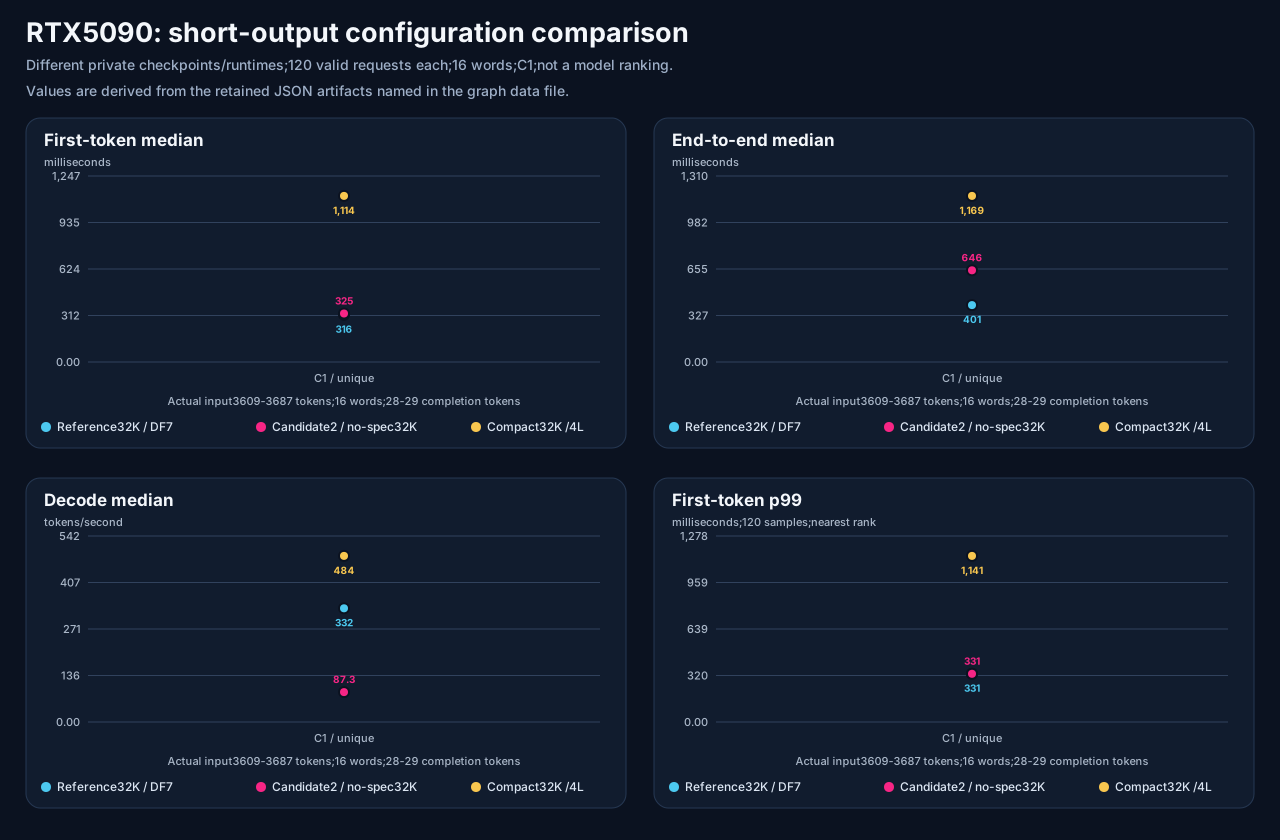
The source-derived chart data retains three distinct 32K profiles with 120 eligible requests each, unique prefixes, canaries, 16 exact words, and roughly 3.6K actual input tokens. Ignis reports 28 completion tokens; the two NInfer cells report 29. Native rates use each runtime's token counts. This is not a matched engine experiment or a sustained long-output estimate. The 32K reference is not the restored 160K reference in the coding table.
Original 128-word cells had no eligible requests. The separate 16-word workload does not rescue those failed cells. Functional serial/overlap stability checks are performance-ineligible and do not prove scheduler concurrency. No general latency SLO is established.
Failures and remaining work
- QAT vision: earliest actionable startup error was “bf16 linear: unsupported shape”; exit 1, no OOM kill. The exact failing tensor is unknown. This is a pinned-runtime/profile failure, not proof against every variant.
- Ignis budget: 1,024 tokens repeated topological-order and zero-capacity cache errors; 4,096 recovered this suite. No universal optimal budget follows.
- Harness: lexical keyword checks accepted a wrong arithmetic answer and were excluded from correctness. Explicit tokenizer protocols and compact context summaries required local fixes; later passes do not rewrite failures.
- Coverage: no repository-task score, routed-client acceptance, video, exact maximum-context boundary, concurrent full contexts or endurance result.
- Publication: identities and output text are deliberately withheld; schemas and numeric states are retained, but public independent replay is limited. See the redaction ledger.
Next work should use held-out repository tasks and declared capability parity, then a fully frozen serving matrix with matched policies and eligible outputs. Those are proposed experiments, not completed work or promotion authority.
The friction log records the chart annotation correction and durable/open dispositions. The restoration receipt and final checks retain the historical ending state. Publication performed no serving action.