Qwen3.8 efficient variants on one RTX 5090
Date: 2026-09-12. Scope: direct text/tools, one 32 GB RTX 5090, llama.cpp, 64K/C1 challengers against the retained 262K/C1 incumbent.
Decision: retain the incumbent; no tested challenger cleared replacement gates. This is a bounded local selection, not a universal model ranking.
Result card
Signal, Swift, Qwopus Flash, and Minitron all served the functional workload on this RTX 5090, but output and quality failures prevented promotion.
| Setup | Retained value |
|---|---|
| Models | Four pinned variants in the managed recipes; exact identities below |
| Hardware | One NVIDIA RTX 5090, 32,607 MiB, sm120, driver 616.64; Windows/Docker/WSL2 |
| Runtime | llama.cpp a298422da78eb75e440a7de0ca408af64d323d93; digest cf2e30bc855cf58cdbdc65d05b5b5e02afa95fb788343a5334d704367ac5c9ac |
| Recipe | Q6_K weights, Q4_0 K/V, full GPU placement, 64K/C1; Signal/Swift MTP3 and matched no-spec controls |
| Measurement path | Direct online loopback; cache state retained per run; some diagnostic quality timings overlap repository tests |
| Contract | Text/tools, thinking on/off diagnostics; 64K configured is not proof of 57K input plus 8K output, nor a 262K replacement |
| Evidence | Functional, diagnostic quality, failed strict capacity and revised short-output scouts; no finalist statistical ranking |
| Decision | Operator authorized best-supported promotion; no challenger qualified. Exact incumbent restored, no route/client changes |
| Headline measurement | Local result | Conditions |
|---|---|---|
| Original candidates completing functional gate | 4/4 | Six checks each, tools 20/20 each, C1 |
| Exact retrieval | 47,349 actual prompt tokens | All four original candidates; nominal filler was 57,344 |
| Signal / Swift strict reasoning screen | 9/10 each | Same ten questions, one attempt, 5,120 combined completion-token cap |
| Qwopus / Minitron strict reasoning screen | 1/10 / 3/10 | Same syntax and budget; format/exhaustion failures count |
| Signal / Swift exact 128-word output | 0/5 each, with and without MTP | Unique canaries, max 512 tokens; failed requests excluded from speed |
Why it matters: a short-answer fine-tune or smaller model is useful only when it finishes the right answer. Repetitive cap-hitting decode is not a win.
Important caveat: this small fixed screen cannot establish broad quality parity, a 2% loss bound, or the incumbent's full-context and client contract.
Artifact manifest · Evidence index · Publication summary.
Outcome and decision
Keep the exact Unsloth Qwen3.8-27B UD-Q4_K_XL/native-MTP3 incumbent. The tested challengers did not satisfy the preregistered failure-free advancement rule. Signal is the most interesting efficiency research lead; its pinned publisher card declares Apache 2.0 (see the source registry). It is not a qualified replacement in this run. Swift tied its initial reasoning screen and has a separately verified commercial-license threshold; eligibility was not assumed. Qwopus and Minitron retained additional quality failures.
The user authorized unattended selection and promotion. No extra permission was needed to decide, but authorization did not justify bypassing correctness or silently reducing context from 262K to 64K. The incumbent's own exact 128-word failure is retained; retaining it is not a claim that it is flawless.
Exact configuration
Repository 948346f5ab553361c6b61d9517b71a0e5e3cfe98, isolated branch
codex/rtx5090-model-bakeoff-20260912, clean at start and campaign-dirty at
completion. Every command used verified python -m anvil_serving.cli from
that worktree. Installed metadata reported 1.0.0 despite v1.2.1 source; exact
module/commit identity was retained instead of treating that string as runtime provenance.
| Profile / served alias | Weight repository and revision | Weight file |
|---|---|---|
Signal / signal38-27b-q6k-mtp3-64k |
agentionai/Signal-3.8-27B-GGUF@9848da210febc2141edb7e3f89cfc307a0d15163 |
AP-Q6_K/Signal-3.8-27B-AP-Q6_K.gguf |
Swift / swift38-27b-q6k-mtp3-64k |
ukisai/Swift-Qwen3.8-27B-GGUF@dfc5e7382fa86bd3b971108e23423be5ef18941e |
Swift-Qwen3.8-27B-Q6_K.gguf |
Qwopus / qwopus38-27b-flash-q6k-nospec-64k |
mradermacher/Qwopus3.8-27B-Flash-i1-GGUF@a2f33e11aa22e467206633d7af9da1990f7111b9 |
Qwopus3.8-27B-Flash.i1-Q6_K.gguf |
Minitron / qwen38-20b-minitron-q6k-nospec-64k |
mradermacher/Qwen3.8-20B-Minitron-i1-GGUF@ef2d8cbbb83bbe27142546665163d2ab9d31727c |
Qwen3.8-20B-Minitron.i1-Q6_K.gguf |
All use the runtime above, batch/microbatch 512/256, eight threads, Flash Attention, Jinja, graph optimization, full GPU layers, and no native KV offload. All exact sampling, draft flags, revisions, cache paths, and served aliases are in recipes and controls. The 3 GiB reserve was not waived. Feasibility produced benchmark survivors, not guaranteed performance or full-context qualification.
Incumbent weights are unsloth/Qwen3.8-27B-GGUF revision
4ca720788d1e01f1bff70c033e0d0028fd02e502, same runtime digest, UD-Q4_K_XL,
native MTP3, 262,144 context. Its API advertises
qwen38-27b-unsloth-ud-q4_k_xl-native-mtp3-262k; earlier artifacts used the
accepted recipe label. See the provenance errata.
Method
Run plan and workload amendments separate the original gates from later diagnostics. Models never graded their own answers. The pinned ten-domain MMLU-Pro fixture uses independent exact answer keys and final-line syntax; it is a sanity screen, not representative MMLU-Pro accuracy. Three repeats test stability on the same questions, not 30 independent topics.
Thinking-enabled scouts requested 1,024 visible allocation plus 4,096 reasoning headroom, but the runtime enforces a combined 5,120-token cap, not separate partitions. Thinking-disabled MMLU uses 1,024 tokens and three repeats. Earlier built-in-only runs used 256 visible tokens and are a different workload. The runtime reports total completion tokens and reasoning characters, not separate reliable reasoning-token counts. Control-normalization warnings remain visible in native evidence; requested controls are not relabeled verified.
Capacity scouts used N5/C1, nominal 4,096 input, explicit unique prefixes, request canaries, max 512 completion tokens, and strict 128-word output. After failures, a distinct 32-word diagnostic retained strict scoring. Cache markers are deterministic across runs, so actual cached-token counters matter. N5 percentiles are descriptive; they are not p99 service-level estimates. No matched, statistically adequate finalist population exists. The chart below is limited to the successful cold-cache N5 short-output diagnostic, with the different serve profiles and uncontrolled CPU load explicitly labeled. The quality artifact's built-in chat timing includes a 32K-class context probe and is not short-chat latency.
Results
| Profile | Thinking-on strict screen | Completion tokens across 10 attempts | Thinking-off repeated MMLU | Strict 32-word diagnostic |
|---|---|---|---|---|
| Incumbent UD-Q4_K_XL/MTP3 | 8/10 | 13,129 | 21/30 | 5/5, cold |
| Signal MTP3 | 9/10 | 10,966 | Not run in original MTP profile | Not run |
| Swift MTP3 | 9/10 | 11,020 | Not run | Not run |
| Signal no-spec | Isolated larger-budget retry failed | Not a ten-question enabled population | 24/30 | 5/5, cold |
| Swift no-spec | Not run | Not run | Not run | 5/5, warm |
| Qwopus no-spec | 1/10 | 12,017 | 24/30 | 5/5, cold |
| Minitron no-spec | 3/10 | 24,580 | 15/30 | 0/5 |
All four original recipes passed smoke, JSON, retrieval, tools 20/20, streaming tools, and tool-result continuation. Signal and Swift passed the earlier repeated built-in intelligence/tool checks; those are not substitutes for the external suite.
Signal and Swift each exhausted the same computer-science question in the thinking-on scout. Signal's later no-spec retry also exhausted 9,216 combined tokens with no final answer. This is a diagnostic changed profile/budget, not an otherwise matched budget-only speed comparison. Qwopus's 1/10 includes eight answer-format failures; several visible answers selected the correct option without the required final syntax. Reinforced syntax plus 2,048 visible tokens yielded 7/10, preserving factual/format and exhaustion failures. Minitron's smaller weights did not prevent factual mistakes or extended reasoning.
The incumbent passed 8/10 in the matched enabled diagnostic, with a chemistry answer failure and the same computer-science budget exhaustion. Signal used 16.5% fewer total completion tokens and Swift 16.1% fewer than its 13,129. Those are configuration-level observations on ten questions, not separate reasoning-token measurements or statistical evidence of general superiority.
With thinking disabled, the incumbent passed 21/30 attempts versus Signal no-spec and Qwopus at 24/30; Minitron passed 15/30. The incumbent exhausted the business, computer-science, and engineering questions at the 1,024-token cap.
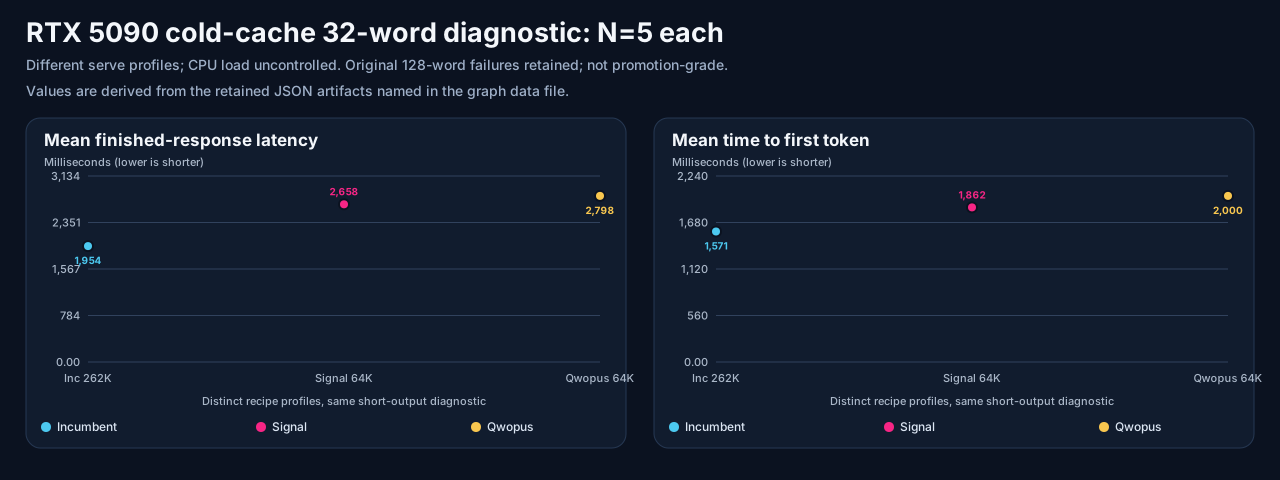
Machine-derived chart data bind each point to its native artifact hash. All three plotted populations finished 5/5 exact 32-word requests with zero reported cached-prompt fraction. Swift's warm population and Minitron's failed population are excluded. This is not a matched MTP speedup or evidence of broader model quality.
The summary and native artifacts contain the final incumbent comparison and request-level failure classes. Do not pool the enabled/disabled or altered-budget populations.
Failures and caveats
- Strict output: the incumbent, Signal, and Swift all failed original 128-word output. Signal/Swift cap-hitting loops cannot be credited as fast useful output. Both still failed without speculation.
- Context: 57,344 nominal filler yielded 47,349 actual input tokens. No challenger qualified the planned actual 57K-plus8K reserve, 262K deployment, multimodal support, real client acceptance, endurance, or broad SWE quality.
- Quality: exact formatting and cap exhaustion are distinct from knowledge errors. Qwopus's known indentation concern did not receive a dedicated executed-Python qualification. The strict scores are intentionally bounded.
- Timing: cache states differ, samples are small, and some diagnostic quality runs overlapped CPU regression tests. These are not clean finalist throughput comparisons or proof of publisher speed claims.
- Fix-forward: managed retained-container lifecycle was missing. Guarded stop/start, admission, immutable fingerprints, timeout/readiness, MCP schema, and regressions were added. Independent review accepts serialized campaign use; general merge/release is held pending shared lifecycle locking and immutable process attestation. Windows Pi startup/pipe polling and a segmented HTTP test reader were separately repaired and independently reviewed.
See the friction log,
lifecycle review,
Pi review,
and the tracked ticket .tickets/2026-09-12-retained-recipe-lifecycle-and-evidence-gaps.md.
Restoration and verification
All candidate containers were removed through managed unload; downloaded weights remain cached. The exact retained incumbent restarted healthy and passed all six preflight checks again, including tools 20/20. The original camera process's executable and start time were checked immediately before preview/apply and it was not terminated. Split ownership returned to the incumbent; the router remained absent as at baseline; shared-memory files were empty. See restoration and sanitized post-run observations.
The final repository regression passed 8,117 tests with 391 skips. Ruff, documentation/evidence consistency, strict documentation build, links, and CLI reference checks passed; see the verification record. Skipped tests and green code checks do not fill missing model/client gates or remove the general lifecycle release hold.
What to test next
A future Signal lower-bit/full-context recipe would require its own feasibility, strict-output, broader coding/quality, context, and client gates. It is not qualified by the present Q6_K/64K results. The prior September 3 quant/runtime comparison remains historical evidence, not a fresh result of this campaign. No weight training or blind runtime migration was attempted to force a winner from a failed profile.
Evidence boundary
Current official and publisher sources are recorded with dates and decision impact in the source registry. Signal/Swift efficiency claims, Qwopus publisher metrics, and Minitron's pruning tradeoff are external priors. Only this card executed the local model workload. Retaining the incumbent preserves the deployment, not a universal claim that it outperforms every available model. No model promotion, route, client-catalog change, controller rebuild, source merge, or package release occurred.
Publication scope
This publication ships the retained benchmark evidence, reproducible candidate registries, documentation indexes and evidence-consistency tests only. The campaign's lifecycle and Windows code fixes remain separate, unmerged work; their recorded regression results describe that campaign tree, not newly released runtime behavior. Publication CI validates the documentation-only commit independently. No package, live service, or model promotion is part of publishing these results.